Rising consumption, especially for ethanol and feed industries, is likely to push domestic demand of Maize to nearly 72 million MT by 2030–31: FICCI-YES Bank Report. NEW DELHI, 15 May 2026: Mr Bhagirath Choudhary, Minister of State for Agriculture and Farmers’ Welfare, Govt of India today while addressing the 12th edition of ‘FICCI India Maize Summit 2026’, said that maize has transitioned from a basic food crop into India’s third-largest food grain, contributing around 14 per cent to total domestic food grain production. “Every part of the maize plant holds direct economic value for food, feed, fodder, or industrial applications. India ranks 4th in terms of maize acreage and 5th in terms of production of maize, in the world,” he added. The Minister stated that growth in Maize sector is driven by yield improvements rather than land expansion, with production rising at an 8.3 per cent CAGR against a 4.5 per cent acreage expansion. “Only 42 per cent of India’s maize area is irrigated, compared to 70 per cent for rice and 95 per cent for wheat, highlighting its role in freshwater conservation. Maize has the potential to generate better farmers income mainly for those who are vulnerable to vagaries of monsoon,” he emphasized.
Mr Choudhary added that the government has announced various policy initiatives to enhance maize productivity, improve farmer income, promote crop diversification, strengthen post-harvest efficiencies and create an enabling ecosystem for sustainable growth of the maize value chain. “The government has recently increased the MSP of maize to Rs 2,410/quintal for the marketing season 2026-27,” he noted. Dr PK Singh, Agriculture Commissioner, Department of Agriculture & Farmers Welfare, Ministry of Agriculture & Farmers Welfare, Govt of India said that maize should also be included in crop diversification strategy. We also need to diversify the use of maize and not be dependent as a source of cattle feed or ethanol production.
Dr Nachiket Kotwaliwale, Director, ICAR-Indian Institute of Maize Research (IIMR) said that around 26 per cent of Maize is now being used for ethanol production, making it a major game changer. This has contributed significantly to India’s energy security. It is not just an economic gain but an important contributor to farmers’ livelihoods and national economy.”
Mr. Subroto Geed, Co-Chair, FICCI Committee on Agriculture and President -South Asia, Corteva Agriscience said, “Transforming India’s maize value chain demands a targeted productivity agenda. With the right seeds, precision agronomy, and technology, we can meaningfully boost productivity and ensure that growth translates into stronger, more stable incomes for farmers. A transformed maize value chain is a direct contribution to the larger vision of a resilient and Viksit Bharat.”
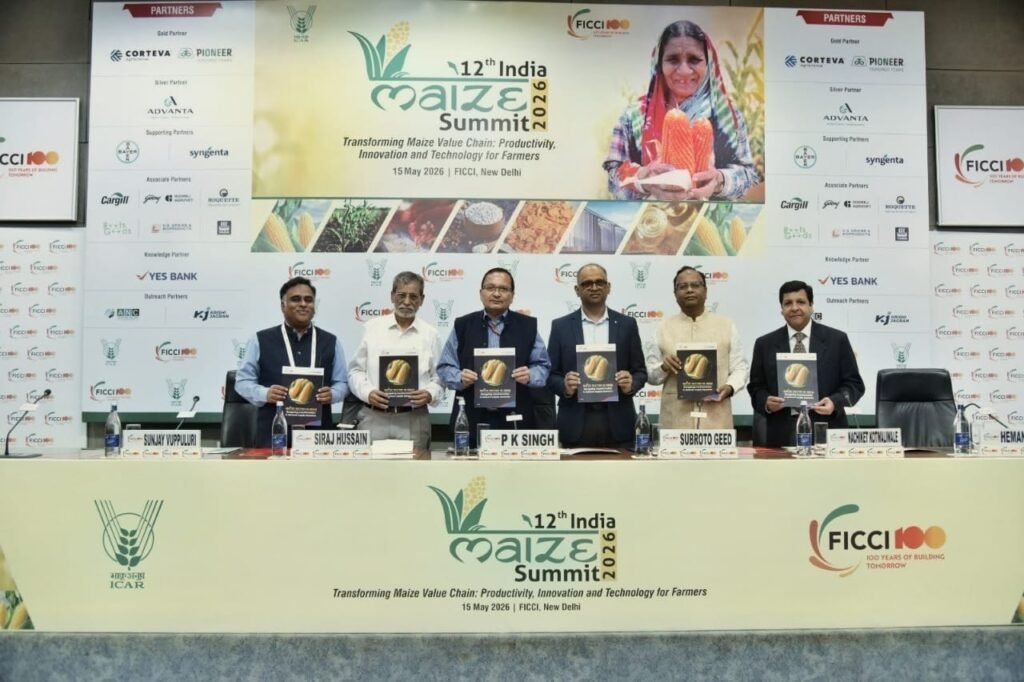
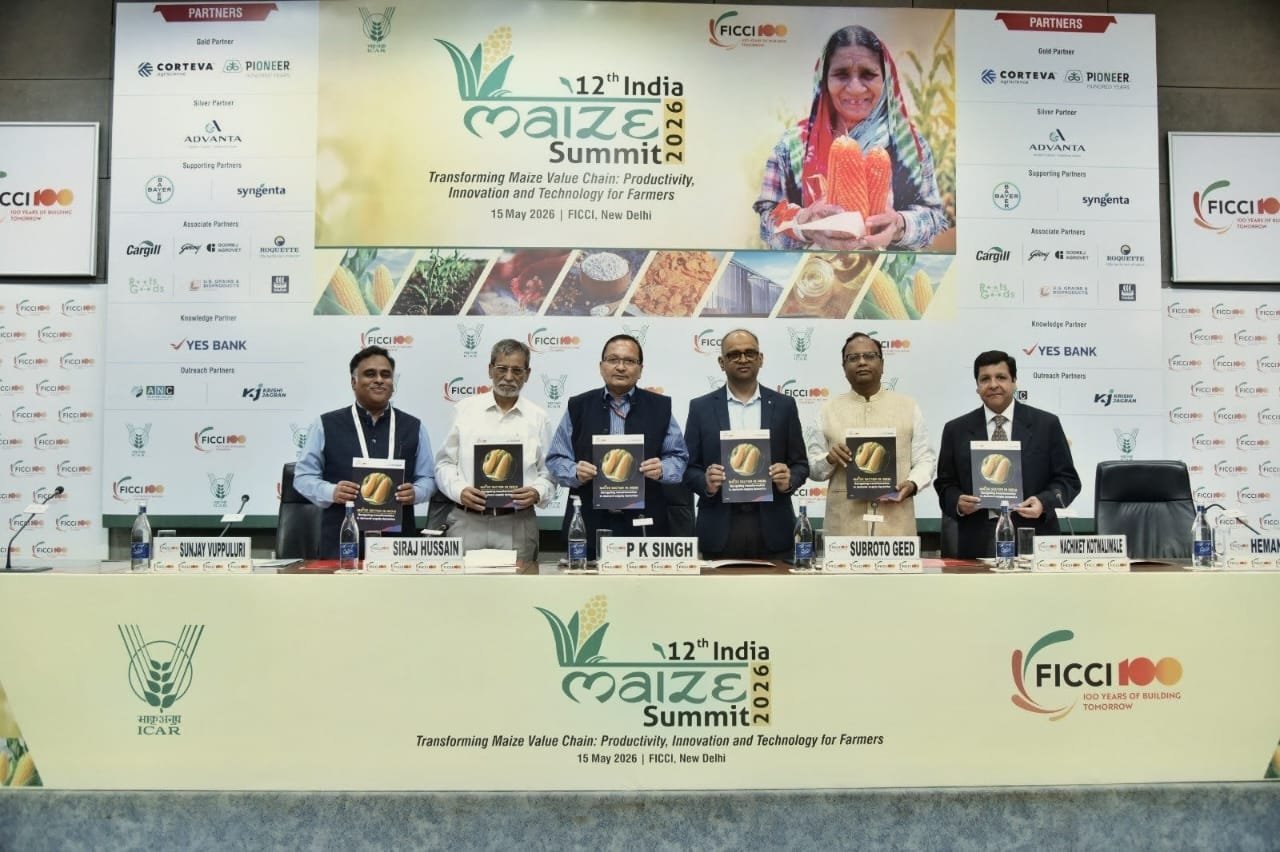
During the event, FICCI-YES Bank report ‘Maize Sector in India: Navigating Transformation in Demand-Supply Dynamics’, was released.
Maize production has increased by more than 120% over the last decade and is expected to touch 50 million MT in 2025-26. Maize is now the third-largest food grain crop in India after wheat and rice. It is also the fastest growing agricultural crop in the country said Mr. Sunjay Vuppuluri, National Head, Food & Agribusiness Strategic Advisory & Research (FASAR), YES Bank.
Mr Siraj Hussain, Advisor, Food Processing, FICCI and Former Secretary, Ministry of Agriculture & Farmers Welfare and Ministry of Food Processing Industries, GoI, while delivering the vote of thanks highlighted the opportunities and challenges in maize sector.
At the 12th India Maize Summit 2026, Federation of Indian Chambers of Commerce and Industry (FICCI) celebrated the International Year of Women Farmers by recognizing and felicitating outstanding women achievers from across the maize value chain. This initiative reaffirms FICCI’s strong commitment to acknowledging the pivotal role of women in agriculture and to advancing inclusive, resilient, and sustainable growth across India’s agricultural ecosystem PDF-(YES BANK-FICCI Report on Maize sector in India Navigating Transformation in Demand-Supply Dynamics)
|
Key highlights of the report
- India’s maize sector is undergoing a significant transformation. Over the last decade, maize has evolved from being a supplementary cereal to becoming a key raw material for multiple industries including animal feed, starch processing, food manufacturing and biofuel production.
- The rapid expansion of industrial demand in India, especially driven by the ethanol blending program and animal feed demand, has positioned maize as a strategically critical crop for India’s economy.
- Global maize production has grown at a CAGR of 1.98% over the last decade (2015 to 2025), increasing from 1,036.9 million MT in 2015 to 1,261.5 million MT in 2025.
- Maize continues to be the fastest growing cereal in India in terms of area, production and productivity. Over the last decade, maize production has nearly doubled from 22.57 million MT (in 2015–16) to about 50 million MT (in 2025–26).
- Rising consumption, especially for ethanol and feed industries, is expected to push the domestic demand levels to nearly 72 million MT by 2030–31.
- Nearly 93% of maize is used for industrial and feed purposes, marking a significant structural shift in demand. On the consumption side, animal feed accounted for about 54% of the total domestic maize use, followed by ethanol (25%) and starch (14%). About 7% was utilized for food, food processing and other uses.
- Despite the growth, maize sector continues to face challenges that constrain the reliability, quality and stability of maize supply. Key challenges include farm-level productivity gaps, heightened climate vulnerabilities and post‑harvest inefficiencies in drying, storage, aggregation and processing. Risks including fungal contamination and aflatoxin incidence, further impact marketability and industrial usage.
- Government has rolled out several policy initiatives, schemes and programs to enhance maize productivity, improve farmer income, promote crop diversification, strengthen post-harvest efficiencies and create an enabling ecosystem for sustainable growth of the maize value chain. Key initiatives include the National Food Security and Nutrition Mission (NFSNM), Soil Health Card Scheme, Pradhan Mantri Fasal Bima Yojana (PMFBY) and ICAR–IIMR’s extensive research pipeline supporting high-yielding and stress-tolerant hybrids.
-
- The report also identifies five key pathways to strengthen the maize ecosystem in India.
- The first is improving farm level productivity through accelerated adoption of high-yielding hybrids, precision agronomy, climate resilient practices and higher mechanization.
- The second is strengthening postharvest handling by scaling scientific drying, storage infrastructure and bulk logistics while promoting FPO-led aggregation models.
- Third, building a robust quality assurance ecosystem by improving moisture management, expanding rapid testing, aligning grading standards and driving awareness on aflatoxin risks.
- Fourth, stabilizing raw material supply for industry by enhancing cluster-based sourcing models, developing long-term procurement frameworks, rationalizing import policies and focusing on industry-specific varietal development for feed, fuel, starch and food sectors.
- Fifth, aligning policies to balance food–feed–fuel priorities by strengthening market intelligence systems, revisiting trade policies and anchoring ethanol expansion on productivity-led growth of maize.
|





 [responsive-slider id=1466]